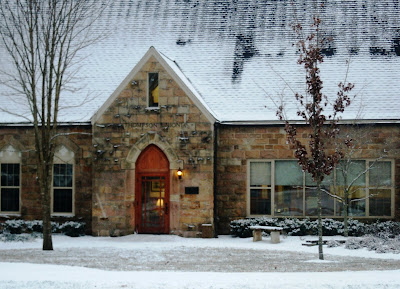
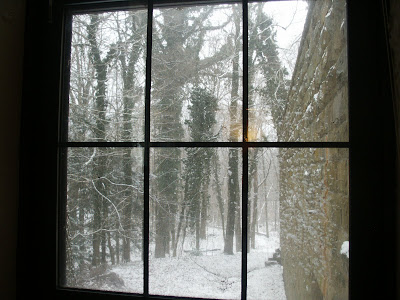
More scenes of a snowy Sewanee. I am beginning to think we may never see the green of the grass again!


Sewanee's campus is beautiful in the fall, and I love to watch the colors change outside my office window.
Welcome, October, my favorite month of the year.
I know I have written so often about the view outside my office window here on the Mountain at Sewanee. Indulge me once again as I marvel at the wildlife and beauty I am treated to on a daily basis.
I've even had coworkers come from neighboring offices to get a look at this handsome fellow. He does strike quite a pose for us...as if he knows we're peering at him through the window.
I love my view and my daily visits by birds, deer, chipmunks, squirrels and the occasional dog on the loose. I just love the world outside my window!
sounds of the music. I am taking a very short break from my hectic day; there is always so much to accomplish in our busy office! But what a magnificent backdrop of beauty we all are fortunate to share while we work! Even at its coldest, Sewanee is a magnificent site to see. Over the last century-and-a-half, many things have been written about the beauty of this place. One such work is by a Mississippi-born alumni of the University, William Alexander Percy, who later went on to accomplish much fame with his writing.
but unless you look for it betimes, you’ll find instead puffs of ghost caught under the higher trees, and that’s dogwood, and puffs of the saddest color in the world that’s tender, too, and that’s redbud, which some say is pink and some purple and some give up but simply must write a poem about. The rest of the flowers you shouldn’t believe in if I told you, so I’ll tell you: anemones and hepaticas and blood-root that troop under the cliffs, always together, too ethereal to mix with reds and yellow or even pinks, and violets everywhere, in armies. The gray and purple and blue sort you’ll credit, but not the tiny yellow ones with the bronze throats, nor the jack-rabbit ones with royal purple ears and faces of pale lavender that stare without a bit of violet modesty. If you’ve seen azalea – and miscalled it wild honeysuckle,
probably – you still don’t know what it is unless you’ve seen it here, with its incredible range of color from white through shell pink to deep coral (and now and then a tuft of orange that doesn’t match anything else in the whole woods), and its perfume actually dangerous, so pagan it is. After it you’d better hunt for a calacanthus with brown petals (what else likes its petal brown?) and a little melancholy in its scent, to sober you. We call our bluets “innocence,” for that’s what they are. They troop near the iris, which when coarsened by gardens some call fleur-de-lis, and others, who care nothing about names, flags.
Our orchids we try to make respectable by christening them “lady-slippers,” but they still look as if they had been designed by D.H. Lawrence – only rose and canary colored.
And so the summer starts – summer, when we’re not seraph-eyed enough to see flowers even if there were any. In the fall, when our souls return, a little worse off, a little snivelly, there are foggy wisps of asters whose quality only a spider would hint at aloud, and in the streams where the iris forgathered there are parnassia, the snowdrop’s only kin. Mountain-folk alone have seen their virginal processions, ankle-deep in water, among scarlet leaves, each holding a round green shield and carrying at the end of a spear, no thicker than a broomstraw, a single pale green star. Last, chilly and inaccessible and sorrowful, in the damp of the woods, come the gentians, sea-blue and hushed."
So is the beauty and procession of colors and seasons here on the mountain. Is it any wonder Percy’s book was a best seller? So lovely are his choice of words, and they leave me longing for spring and its fine display…for the fields of daffodils, tiny crocus, the scent of honeysuckle and fresh, soft earth as I walk through Abbo’s Alley. Today, I am content with the dark silhouettes of bare trees vaguely visible through the haunting fog, but in my heart is a longing for the time when the mountain comes alive again after its long winter sleep.
If you are interested in reading more of Percy’s work, the LSU press reprinted Lanterns on the Levee in 2006, ISBN-13: 978-8071-0072-1. Percy also published five books of poetry, listed below:
May you stay warm this cool January day, and may your dreams of spring soon come true!